Field Notes on Stain Chemistry: What Actually Lifts It, and What Sets It Forever
Field Notes on Stain Chemistry: What Actually Lifts It, and What Sets It Forever
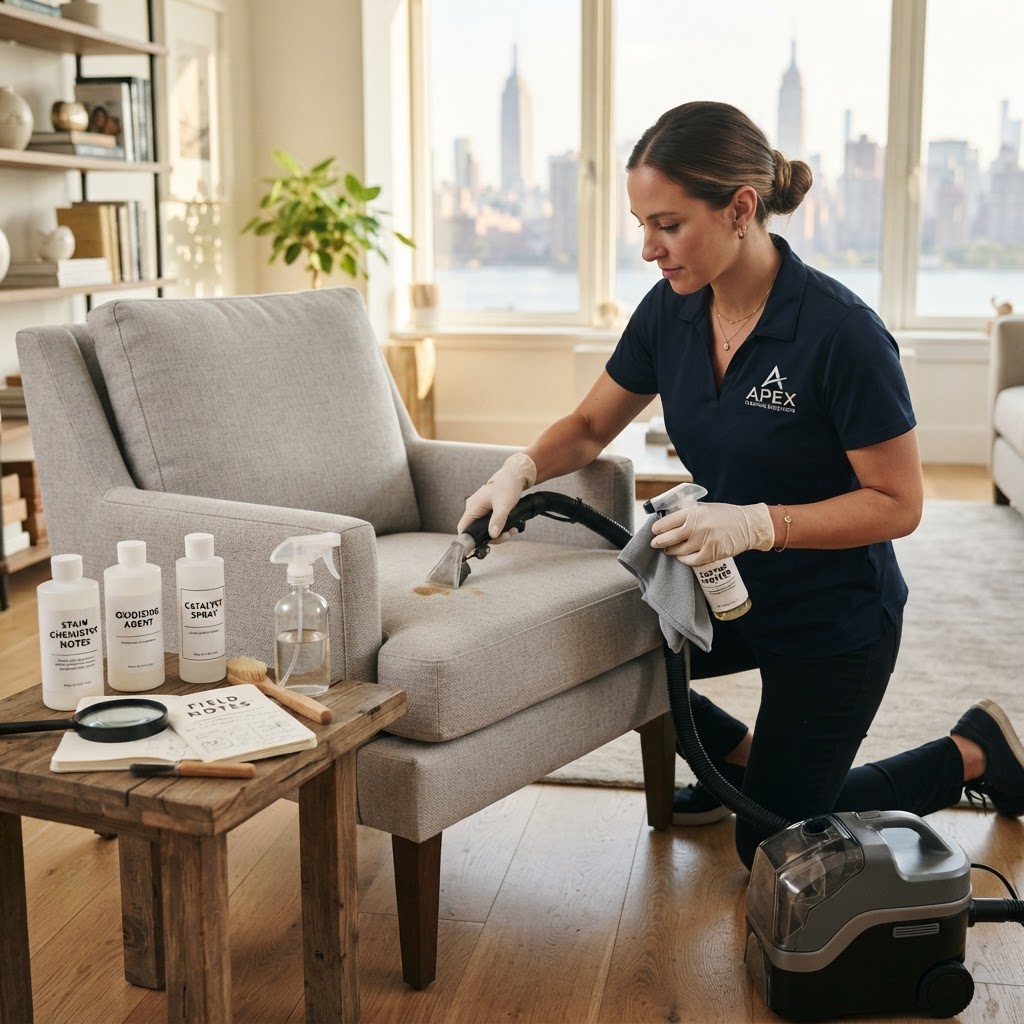
The first thing I teach a new technician is that there is no such thing as a good all-purpose cleaner for stains. There are only correct pairings between a soil and a chemistry, and a much longer list of incorrect ones that make things permanently worse.
I have pulled fifteen-year-old red wine out of a Riverdale living room carpet and I have watched a homeowner in Montclair destroy a white cotton sofa with a bleach pen in under thirty seconds. The difference was not effort. It was knowing what the stain was made of.
Here is the training material, more or less as our field crews get it.
Everything Starts with pH
The pH scale runs 0 to 14. Below 7 is acidic, 7 is neutral, above 7 is alkaline. Every cleaning product you own sits somewhere on it, and the entire logic of stain removal is this:
Alkaline chemistry dissolves acidic and organic soils. Acidic chemistry dissolves alkaline and mineral soils.
That is it. That is the core of the job.
- Alkaline (pH 8–13): degreasers, most all-purpose cleaners, oven cleaner, ammonia, baking soda. Attacks grease, protein, food, body oil, most soil tracked in off a sidewalk.
- Acidic (pH 1–6): vinegar, citric acid, phosphoric acid, descalers, rust removers. Attacks limescale, hard water spots, soap scum, rust, urine crystals, efflorescence.
- Neutral (pH 7–8): the safe default for finished floors, natural stone, and anything you are unsure about.
Where crews get in trouble is applying the wrong side of the scale. Alkaline cleaner on marble will dull it over time; acidic cleaner on marble will etch it immediately. Strong alkaline on wool carpet will yellow it, because wool is a protein fiber and alkaline chemistry attacks protein. This is exactly why the same product that saves a synthetic carpet ruins a wool rug.
The Four Families of Soil
Before you choose chemistry, identify the family.
- Protein — blood, milk, egg, sweat, vomit, pet accidents. Sets permanently with heat. Never use hot water on protein.
- Tannin — coffee, tea, red wine, fruit juice, beer. Plant-derived. Responds to oxidizers and mild acids. Sets with alkaline soap.
- Oil and grease — cooking grease, body oil, cosmetics, motor oil, most food residue on kitchen surfaces. Responds to alkaline chemistry and solvents.
- Dye and pigment — ink, marker, shoe polish, hair color, some food colorings. Requires solvents or reducing agents. The hardest category.
A surprising amount of real-world stains are combinations. A pizza grease stain on carpet is oil plus tannin plus pigment, which is why it needs a sequence rather than a single product.
The Five Tools in the Chemical Kit
Surfactants reduce surface tension so water can penetrate and so soil can be suspended and carried away. Every soap and detergent works on this principle. They do not destroy anything; they lift and hold it in solution so you can remove it.
Solvents dissolve like with like. Oil dissolves oil. Citrus terpenes, mineral spirits, and isopropyl alcohol are common solvents in the field. Solvents are how you attack grease, adhesive, gum, and ink.
Oxidizers break the chemical bonds that make a stain visible — specifically, they attack the chromophore, the part of the molecule that reflects color. Hydrogen peroxide and sodium percarbonate are the workhorses. Chlorine bleach is an oxidizer too, but a much less selective one; it removes the stain and frequently the fabric's own color along with it.
Enzymes are biological catalysts that digest specific molecule types. Protease breaks down protein, lipase breaks down fat, amylase breaks down starch. They are slow — they need dwell time measured in tens of minutes, sometimes hours — and they are the only correct answer for pet urine.
Acids and chelators dissolve or bind mineral deposits. Citric acid, phosphoric acid, and EDTA fall here. This is your answer for anything that came out of a pipe rather than out of a person.
The Stain Index
Red Wine
Tannin plus pigment. Blot immediately, never rub — rubbing drives it into fiber and spreads the perimeter. Apply cold water and blot again. Then hydrogen peroxide with a drop of dish soap, applied and allowed to dwell for a few minutes before blotting.
The salt trick works on fresh spills through capillary action, but only while the stain is still wet, and it does nothing for a dried one. The old advice about white wine neutralizing red wine is dilution, not chemistry — water does the same thing for free.
Blood and Protein
Cold water only. Heat coagulates protein and locks it into the fiber permanently. Cold water, then an enzyme cleaner, then dwell time. Hydrogen peroxide works on white and colorfast fabrics but must be tested first.
Every year someone throws a bloodstained sheet in a hot wash and calls us afterward. At that point we are managing expectations, not removing a stain.
Grease and Oil
On fabric and carpet: absorb first with cornstarch or baking soda, let it sit twenty minutes, vacuum it up, then hit the residue with a solvent-based spotter or dish soap, which is engineered specifically for this problem.
On kitchen surfaces: alkaline degreaser with genuine dwell time. Baked-on range hood grease needs the product to sit and soften — five to ten minutes minimum. Crews that scrub immediately are doing three times the labor for a worse result.
Hard Water and Limescale
Common throughout the region. Calcium and magnesium carbonate deposits are alkaline, so they need acid — white vinegar for light scale, citric acid for moderate, a commercial descaler for heavy buildup on glass shower doors.
Never on marble, travertine, limestone, or terrazzo. On those, mineral deposits are handled mechanically with polishing compound, because the deposit and the stone are chemically similar and acid cannot tell them apart.
Rust
Oxalic acid or a dedicated rust remover. Bleach makes rust dramatically worse by oxidizing it further — this is one of the most common and most permanent DIY mistakes we encounter.
Pet Urine
The problem is not the visible stain. Urine deposits uric acid crystals that bond to fiber and rebloom every time humidity rises, which is why a spot cleaned in January smells again in July.
Enzyme cleaner, applied in enough volume to reach the full depth of the contamination — including the pad and often the subfloor — with hours of dwell time. Do not use ammonia-based cleaners; ammonia is a component of urine odor and reads to a dog as a marking site. Steam cleaning a urine spot before enzyme treatment bakes the protein in permanently.
Coffee and Tea
Tannin. Blot, cold water, then mild acid or oxidizer. Adding regular soap first can set it — this is the counterintuitive one that catches people, because soap feels like the obvious first move.
Ink and Marker
Solvent territory. Isopropyl alcohol on a white cloth, blotting from the outside edge inward to keep the stain from spreading. Work in small increments and change to a clean section of cloth constantly. Ballpoint responds well; permanent marker and gel ink often do not. Alcohol will strip finish from wood and some plastics, so test.
Urban Soot and Filtration Soiling
Distinctly a New York and North Jersey problem. If you see gray or black lines along the edges of a carpet where it meets the wall, under a doorway, or along a baseboard, that is filtration soiling: air moving through gaps pulls fine particulate through the carpet, which acts as a filter.
It is not a cleaning failure. It is a building air pressure issue. It requires solvent pre-treatment and aggressive agitation with a specialized tool, and it will return unless the air gap is sealed. We tell clients this up front rather than promise a permanent fix we cannot deliver.
The Three Rules Every New Tech Learns
1. Always test in an inconspicuous area. Inside a closet, under a sofa, on the back of a cushion. Ten seconds of testing prevents a replacement invoice.
2. Work from the outside in. Every time. Working outward spreads the perimeter and creates a halo you will then have to clean too.
3. Blot, never rub. Rubbing distorts fiber, breaks the pile, and creates a permanent texture change that reads as a stain even after the color is gone. On a cut-pile carpet, the damage from rubbing frequently outlasts the stain itself.
The Equipment That Does the Heavy Lifting
Our crews carry more than a caddy and a mop. The gear matters as much as the chemistry.
- HEPA-filtration backpack vacuums. Faster than upright units in real spaces, and the filtration is the point. A vacuum that exhausts fine particulate back into a Manhattan studio is making the air worse while making the floor look better.
- Hot water extractors. For carpet restoration and upholstery. Depth of rinse and recovery is what separates extraction from surface cleaning.
- Color-coded microfiber, changed constantly. Ours runs blue for general surfaces, yellow for kitchen, red for restroom, green for glass. This is cross-contamination control, and it is non-negotiable. A cloth that touched a toilet does not touch a countertop, ever.
- Flat mop systems with disposable or laundered pads. String mops and buckets redistribute dirty water. We do not use them.
- pH test strips. For verifying rinse completion on floors. Residual alkaline cleaner left on a floor attracts soil and makes the next clean worse.
Safety: The Mixes We Never Make
This section exists because these mistakes are made in homes constantly, not in our operation.
- Bleach + ammonia produces chloramine gas
- Bleach + any acid — including vinegar and many toilet bowl cleaners — produces chlorine gas
- Bleach + rubbing alcohol produces chloroform and other chlorinated compounds
- Hydrogen peroxide + vinegar stored together produces peracetic acid
- Two different drain products in sequence — unpredictable and genuinely dangerous
Every technician on our roster completes chemical handling and PPE training before their first solo assignment, and our safety data sheets travel with the crew. When we tell a client we cannot do a particular job — certain hood systems, certain pre-1978 post-construction work — it is because the job requires certification or respiratory protection beyond that crew's qualification, and we would rather say no than send someone into it unequipped.
When the DIY attempt has run out of road, call in the chemistry.
Lunexa Cleaning Co. delivers trained, equipment-backed deep cleaning for homes and businesses across all five New York City boroughs and Northern New Jersey. Our technicians are trained on soil identification, substrate compatibility, and chemical safety before they ever work independently — because the fastest way to ruin a floor is to guess.
Residential clients: book a deep clean at flat published pricing on our booking page. Commercial and property managers: request a scoped quote through the chat window on this page.